


How accurate is the oil change indicator?


Thread Starter
Joined: Sep 2015
Posts: 4
 How accurate is the oil change indicator?
For my 2009 Accord, I had an oil change at 105k miles with full synthetic. I now have close to 112k miles and the oil indicator says the level is at 70%. I usually get an oil change every 7k miles so I don't think 70% is accurate?

Super Moderator
Joined: Aug 2012
Posts: 3,070
From: Southern New Hampshire
Assumption:
Honda uses a similar algorithm compared to other manufacturers.
The OLM (Oil Life Monitor) capabilities in modern cars is quite accurate on the conservative side. If your OLM typically recommends a 7,000 mile oil change, and this particular oil change is indicating longer, it is probably because you have changed your driving environment, say gone from mostly urban to mostly highway. Have you taken a long trip recently?

Senior Member
Joined: Apr 2015
Posts: 712
From: Cincinnati, OH
My Accord's oil info is showing 60% at 3,600 miles on the vehicle, however, the car is almost a year old (purchased in February, 2015).. I've an appointment at the dealership this Friday to have the oil changed. When I bought the car, they told me that under conditions that I drive, I should get 15K miles or one year (which ever came first) before the first oil change

Been Around A Long Time Member
Joined: May 2010
Posts: 908
From: Washington State, USA
No would be my answer.
Look, EPA got to manufacturers to reduce the generation of used motor oil volumes. Better, different oil components and longer change intervals resulted - to generate less used oil volume in the USA. Individual car motor, or car owner, benefit wasn't the driver for the less-old-oil-volume instruction.
I look at my X,000 mile oil change interval and figure (without oil indicator) ... what fraction of my engines lubrication based wear happens in the first 60% vs. the last 40% of the miles. So I change oil early enough because I want my car to last for me, and honestly, for the next owner too.
Also worked next to a research engineer from Chevron's oil dept, but that's too long to communicate.
$.02 ... continue.
Look, EPA got to manufacturers to reduce the generation of used motor oil volumes. Better, different oil components and longer change intervals resulted - to generate less used oil volume in the USA. Individual car motor, or car owner, benefit wasn't the driver for the less-old-oil-volume instruction.
I look at my X,000 mile oil change interval and figure (without oil indicator) ... what fraction of my engines lubrication based wear happens in the first 60% vs. the last 40% of the miles. So I change oil early enough because I want my car to last for me, and honestly, for the next owner too.
Also worked next to a research engineer from Chevron's oil dept, but that's too long to communicate.
$.02 ... continue.

Super Moderator : And A Texan
Joined: Feb 2007
Posts: 9,652
From: Katy, TX
Another question nobody can answer, but only give opinion.
I have trusted Acura for oil changes on my vehicles w/ oil change monitoring and so far OK. I checked valve clearances on my 10 TSX the other day and valve train looked new w/ only a couple of exhaust valves justifying adjustment.
Your choice will be as good as any.
I would also suspect an accidental reset. I've never seen interval much different from 7500 miles.
good luck
I have trusted Acura for oil changes on my vehicles w/ oil change monitoring and so far OK. I checked valve clearances on my 10 TSX the other day and valve train looked new w/ only a couple of exhaust valves justifying adjustment.
Your choice will be as good as any.
I would also suspect an accidental reset. I've never seen interval much different from 7500 miles.
good luck
Super Moderator
Joined: Aug 2012
Posts: 3,070
From: Southern New Hampshire
No would be my answer.
Look, EPA got to manufacturers to reduce the generation of used motor oil volumes. Better, different oil components and longer change intervals resulted - to generate less used oil volume in the USA. Individual car motor, or car owner, benefit wasn't the driver for the less-old-oil-volume instruction.
I look at my X,000 mile oil change interval and figure (without oil indicator) ... what fraction of my engines lubrication based wear happens in the first 60% vs. the last 40% of the miles. So I change oil early enough because I want my car to last for me, and honestly, for the next owner too.
Also worked next to a research engineer from Chevron's oil dept, but that's too long to communicate.
$.02 ... continue.
Look, EPA got to manufacturers to reduce the generation of used motor oil volumes. Better, different oil components and longer change intervals resulted - to generate less used oil volume in the USA. Individual car motor, or car owner, benefit wasn't the driver for the less-old-oil-volume instruction.
I look at my X,000 mile oil change interval and figure (without oil indicator) ... what fraction of my engines lubrication based wear happens in the first 60% vs. the last 40% of the miles. So I change oil early enough because I want my car to last for me, and honestly, for the next owner too.
Also worked next to a research engineer from Chevron's oil dept, but that's too long to communicate.
$.02 ... continue.
Been Around A Long Time Member
Joined: May 2010
Posts: 908
From: Washington State, USA
You'd be correct if someone lived in New England like you do and where they salt the roads in winter.
In Pacific Northwest (and west in general) winter sand is used rather than salt and car bodies last a long time if they're garaged.
When I visit New England (Connecticut), I'm struck by how new all the cars are - and then I think,
oh yeah - the cars all rust out after 8 years.
And when I drove back there in October I was actually pulled over by Connecticut State Trooper on a goofy premise that my windows
were too darkly tinted, but probably because he wanted to see what a clean old car was doing in his area with west coast plates. No ticket.
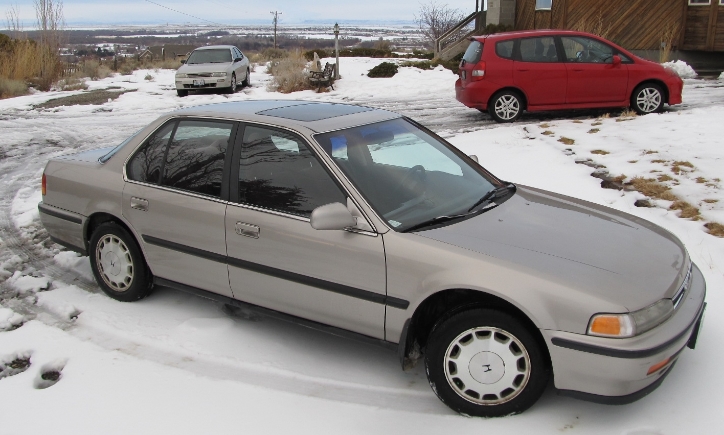
Here's my 24 yr old Accord. Yeah photo'd a couple years ago, but unchanged today at nearly 248,000 miles.
Last edited by UhOh; Jan 16, 2016 at 06:28 AM.
Super Moderator
Joined: Aug 2012
Posts: 3,070
From: Southern New Hampshire
I'm not sure where you get the idea that cars rust out after only a few years, my 15 year old Accord (with only 170,000 miles on the clock) has no rust, neither does my 17 year old Chrysler Town & Country with over 200,000 miles on the clock. I stand by my statement; change the oil per the factory recommendation and the engine will outlast the rest of the car.
Regarding your comment of when engine wear occurs during an oil change interval, I'll give you the statistics:
Regarding your comment of when engine wear occurs during an oil change interval, I'll give you the statistics:
- During the first 60% of the miles in an oil change, 60% of the wear occurs
- During the final 40% of the miles in an oil change, 40% of the wear occurs
Last edited by shipo; Jan 16, 2016 at 07:17 AM.

