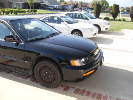
Accord can be fast?

Unregistered
Posts: n/a
 RE: Accord can be fast?
a more accurate name for FWD applications would be a traction bar. they keep the front tires planted harder, argue with physics if you want, you're going to loose, every time. adding a wheelie bar is like effectively having a solid rear suspension setup which result in less rear end squat under acceleration. lt effectively lengthens your wheel base when the traction bars come into contact with the track, which makes weight transfer harder

Been Around A Long Time Member
Joined: Aug 2007
Posts: 6,213
From: Wayne, NJ
RE: Accord can be fast?
I'm not arguing with physics .... I'm using physics for my arguement. Ok, so you want to call it a traction bar. Fine! If the car's systems are set up correctly, it still just adds weight. Unless the rear of the car is lifted and the bar placed lower than the rear wheels or the bar has a massive torsion spring on it, it will never touch the ground. If these were done, it still wouldn't help with anything at all!!!! Please show me the physics that you claim that I am arguing against. Now if we were talking about a wheel with a lifting mechanism to change the stance of the car, I'd think that would work, but then again you change the stance from the suspension.
I'm not convinced that a wheelie bar or a traction bar provides any benefit to a properly built FWD vehicle.
I'm not convinced that a wheelie bar or a traction bar provides any benefit to a properly built FWD vehicle.
Unregistered
Posts: n/a
RE: Accord can be fast?
which is stiffer, a solid frame, or coilovers with a high spring rate? true a properly built setup would have minimum give in the rear, but i believe it would be the conservation of momentum that i awould be agreeing with. all the non rotating weight( not accelerating, but rather being pulled along) will want stay stationany and will rotate along any axis possible towards the direction that the car is not going. IE rear end sqauts under accelration. if you lengthens the wheel base under acceleration the weight is transfered back up to the front once the load is put on the traction bars, they are not allowed to be in contact with the track at the start of the race but you want them as close as possible. we're talking like .01" so that as soon as there is any acceleration the load gets transfered to the traction bars effectivly lengthening the wheel base and causing the pivot point to be as far back as possible which would hold more weight on the front wheels.
Been Around A Long Time Member
Joined: Aug 2007
Posts: 6,213
From: Wayne, NJ
RE: Accord can be fast?
what you've described requires a significant preload like I mentioned .... what I'm saying is that by adjusting the height of the suspension, the track car can be preloaded via weight distribution .... like a 70-30 split. Also, launch setups have very stiff springs.

Senior Member
Joined: Feb 2006
Posts: 6,290
From: Montana
RE: Accord can be fast?
Just because I want to stick my nose in here I'd assume that a wheelie bar (or whatever you want to call it) is more of a "band aide" for an improperly setup suspension, and a cheaper temporary solution

Been Around A Long Time Member
Joined: Aug 2007
Posts: 6,213
From: Wayne, NJ
RE: Accord can be fast?
Not so much an arguement as a debate. I don't argue because that implies blindly asserting a point whereas we are discussing the physical reality of how the system can work or not work. I agree with the band-aid comment from Sir_Nasty and I understand how it CAN work, I just don't agree that a well-built, properly setup FWD would benefit from a traction bar. I think it's mainly a carry-over from RWD racing and as mentioned is a band-aid fix, similar to how turbo exhaust piping has made it's way into NA cars.

Senior Member
Joined: Oct 2005
Posts: 955
From: southern california
RE: Accord can be fast?
wheelie bars really help, look at this honda insight.
http://www.youtube.com/watch?v=R3EPuc9nI8A
9.6 1/4 mile with an NA f22 motor!
http://www.youtube.com/watch?v=R3EPuc9nI8A
9.6 1/4 mile with an NA f22 motor!