


I'm having trouble getting my head unit to control my subs.


Thread Starter
|
Junior Member
Joined: Sep 2009
Posts: 52
From: Minnesota

If you are now having other electrical issues, you may have crossed some wires.
You should have a Power wire (with a in line fuse very close to the battery) from the + battery terminal to the + terminal on the cap.
On the same + terminal of the cap, you will have a wire running from the + cap to the + input on the amp.
On the - terminal on the cap, you will have a wire running to the - on the amp and another wire from the - on the cap to the ground on the car.
Also, you need to SLOWLY charge your cap whenever you are about to reconnect your battery. If not, you will see a large spark and this hurts the battery/cap life. I made my own slow charger by using a $3 interior dome socket and a 12v bulb from an auto parts store. When you are hooking back the the battery up, hook the + side up normally, then run one wire of the slow charger from the - battery terminal to the - wire you are about to hook up. When the light goes out, hurry and put the - wire on the - battery terminal.
You should have a Power wire (with a in line fuse very close to the battery) from the + battery terminal to the + terminal on the cap.
On the same + terminal of the cap, you will have a wire running from the + cap to the + input on the amp.
On the - terminal on the cap, you will have a wire running to the - on the amp and another wire from the - on the cap to the ground on the car.
Also, you need to SLOWLY charge your cap whenever you are about to reconnect your battery. If not, you will see a large spark and this hurts the battery/cap life. I made my own slow charger by using a $3 interior dome socket and a 12v bulb from an auto parts store. When you are hooking back the the battery up, hook the + side up normally, then run one wire of the slow charger from the - battery terminal to the - wire you are about to hook up. When the light goes out, hurry and put the - wire on the - battery terminal.
Yeah i heard about that. Is there a maximum wattage the cap can hit when it's charged that way? Right now i can hit about 15 when my car is on.


Thread Starter
|
Junior Member
Joined: Sep 2009
Posts: 52
From: Minnesota
Alright thanks for the pics. Does the size of the wire matter for the speakers? since i'm noticing he used like 8 gauge. it looks like. at least twice the size of the 12 gauge.
Last edited by MinnesotanHonda; Feb 18, 2010 at 10:15 PM.

Super Moderator
Joined: Dec 2009
Posts: 3,279
From: Quad Cities, IL
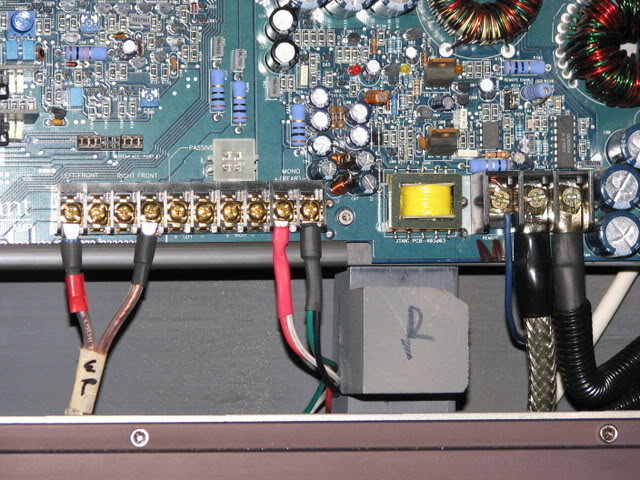
the pics above are from some of my installs. the top one has 4 awg back to a distribution to 8awg for power and ground. neither amp draws more than 60A so 8awg was fine. 12awg was used for speakers.
the middle pic is a close up of a spade terminal connection for a processor.
the bottom pic is another amp termination pic. you can see that i use spade terminals and heat shrink or covers.
BTW - i'm leaving town for a few days. good luck with the testing this weekend.
the middle pic is a close up of a spade terminal connection for a processor.
the bottom pic is another amp termination pic. you can see that i use spade terminals and heat shrink or covers.
BTW - i'm leaving town for a few days. good luck with the testing this weekend.
Thread Starter
|
Junior Member
Joined: Sep 2009
Posts: 52
From: Minnesota
I just realized that the guy i bought these from had the speakers wired for mono.So 2 wires into the all the way left terminal. and 2 into the all the way right. Basically he had 2 subs wired for mono. So i'm guessing that could have blown the fuse along with the 60% gain. I'm just hesitant to move the gain from the min.
http://www.sonicelectronix.com/pictu...cture_id=97836

http://www.sonicelectronix.com/pictu...cture_id=97836
Last edited by MinnesotanHonda; Feb 22, 2010 at 04:44 PM.
Super Moderator
Joined: Dec 2009
Posts: 3,279
From: Quad Cities, IL
undo what he did. he wired it for 2 ohm mono - that would explain your problem.
thanks for figuring that out, it confirms my suspicions.
change the wiring one of two ways.
1) one sub per channel - one wire per terminal.
2) wire the subs in series and keep them mono - like this

you can simply disconnect one positive and one negative wire from the terminals, and then connect them together. one positive and one negative wire will remain in the far left and far right teminals.
I like option 2 for a few reasons -
the 8 ohm mono load will be very easy on the amp, very little heat, and increased dampening factor means more control. However, clipping will be a concern, so your gain must be properly set with a DMM so you know you're getting the proper voltage out.
Option 1 is probably your easiest method and wiring it like that should allow it to work.
Either option should result in the same amount of power available to the woofers.
thanks for figuring that out, it confirms my suspicions.
change the wiring one of two ways.
1) one sub per channel - one wire per terminal.
2) wire the subs in series and keep them mono - like this
you can simply disconnect one positive and one negative wire from the terminals, and then connect them together. one positive and one negative wire will remain in the far left and far right teminals.
I like option 2 for a few reasons -
the 8 ohm mono load will be very easy on the amp, very little heat, and increased dampening factor means more control. However, clipping will be a concern, so your gain must be properly set with a DMM so you know you're getting the proper voltage out.
Option 1 is probably your easiest method and wiring it like that should allow it to work.
Either option should result in the same amount of power available to the woofers.
Thread Starter
|
Junior Member
Joined: Sep 2009
Posts: 52
From: Minnesota
Okay good.I thought something was iffy about 2 wires on one side and then 2 on the other. They barely fit, and there weren't any connectors attached, just raw wire. SO what i did was cut the ends off and put on spades on each wire. So far everything is going fine and i have them wired correctly. I've just kept the gain level low so i don't blow a fuse. Hopefully in me changing the wiring to the terminals it won't happen again.
Thank you for all your help.
Thank you for all your help.
Super Moderator
Joined: Dec 2009
Posts: 3,279
From: Quad Cities, IL
good to hear.
you can adjust the gain for more output. here's how to do it using your ears:
download a 50Hz test tone.
determine your max volume for music through speakers - how loud you'll play without the speakers distorting.
turn off speakers (either turn off internal amp, or set high pass crossover to highest setting)
set sub gain to min
play 50Hz tone on head unit, on repeat
if the HU has a sub level control, set it to max
increase head unit volume to your predetermined max, verify the speakers aren't playing anything
climb in trunk near subs and amp
increase sub amp gain until you just start to hear distortion, note this level.
turn HU volume down, remove test tone disc, turn on speakers - reset sytem
now listen to the system. if you think the bass is too loud then you can turn the gain down from here - if the HU has a sub level control, you can adjust this down instead of the amp gain so you can realize the full output of the subs.
the purpose of gain is to give you an adjustment for your head unit output voltage. if you have a high head unit preout voltage, gain will be near min, if the preout voltage is low, gain may be near max.
you can adjust the gain for more output. here's how to do it using your ears:
download a 50Hz test tone.
determine your max volume for music through speakers - how loud you'll play without the speakers distorting.
turn off speakers (either turn off internal amp, or set high pass crossover to highest setting)
set sub gain to min
play 50Hz tone on head unit, on repeat
if the HU has a sub level control, set it to max
increase head unit volume to your predetermined max, verify the speakers aren't playing anything
climb in trunk near subs and amp
increase sub amp gain until you just start to hear distortion, note this level.
turn HU volume down, remove test tone disc, turn on speakers - reset sytem
now listen to the system. if you think the bass is too loud then you can turn the gain down from here - if the HU has a sub level control, you can adjust this down instead of the amp gain so you can realize the full output of the subs.
the purpose of gain is to give you an adjustment for your head unit output voltage. if you have a high head unit preout voltage, gain will be near min, if the preout voltage is low, gain may be near max.
Thread Starter
|
Junior Member
Joined: Sep 2009
Posts: 52
From: Minnesota
good to hear.
you can adjust the gain for more output. here's how to do it using your ears:
download a 50Hz test tone.
determine your max volume for music through speakers - how loud you'll play without the speakers distorting.
turn off speakers (either turn off internal amp, or set high pass crossover to highest setting)
set sub gain to min
play 50Hz tone on head unit, on repeat
if the HU has a sub level control, set it to max
increase head unit volume to your predetermined max, verify the speakers aren't playing anything
climb in trunk near subs and amp
increase sub amp gain until you just start to hear distortion, note this level.
turn HU volume down, remove test tone disc, turn on speakers - reset sytem
now listen to the system. if you think the bass is too loud then you can turn the gain down from here - if the HU has a sub level control, you can adjust this down instead of the amp gain so you can realize the full output of the subs.
the purpose of gain is to give you an adjustment for your head unit output voltage. if you have a high head unit preout voltage, gain will be near min, if the preout voltage is low, gain may be near max.
you can adjust the gain for more output. here's how to do it using your ears:
download a 50Hz test tone.
determine your max volume for music through speakers - how loud you'll play without the speakers distorting.
turn off speakers (either turn off internal amp, or set high pass crossover to highest setting)
set sub gain to min
play 50Hz tone on head unit, on repeat
if the HU has a sub level control, set it to max
increase head unit volume to your predetermined max, verify the speakers aren't playing anything
climb in trunk near subs and amp
increase sub amp gain until you just start to hear distortion, note this level.
turn HU volume down, remove test tone disc, turn on speakers - reset sytem
now listen to the system. if you think the bass is too loud then you can turn the gain down from here - if the HU has a sub level control, you can adjust this down instead of the amp gain so you can realize the full output of the subs.
the purpose of gain is to give you an adjustment for your head unit output voltage. if you have a high head unit preout voltage, gain will be near min, if the preout voltage is low, gain may be near max.
Super Moderator
Joined: Dec 2009
Posts: 3,279
From: Quad Cities, IL
other than having an internal amp on/off control or high pass filter control, no. really, if you have subs, you should have some sort of high pass filter on the speakers. even if it's just simple "bass blockers", i.e. non-polarized 63V capacitors. those speakers shouldn't see 50Hz, ideally.

