


03 Accord Window Problem


Super Moderator
Joined: Oct 2010
Posts: 7,099
From: United States

This is just a generic image that is sideways, the cable runs in between the track.
http://ecx.images-amazon.com/images/I/41qEUCFMPPL.jpg
http://ecx.images-amazon.com/images/I/41qEUCFMPPL.jpg

Newest Of Newbies
Joined: Aug 2014
Posts: 16
Finally got around to installing a new motor/regulator assembly. When I plugged in the passenger switch the window went up/down like it should so I thought yippe, success! Then I started getting a lot of erratic behavior. The window worked when I first turned the key to on but then after hearing 2-3 clicks and clunks(relay?) in the passenger door it stopped working. When it was working the auto up/down did not work. A couple of times the window decided to go back up by itself! I tried doing all of the re-set procedures that are at the end of the Dorman instructions. Also disconnected both battery cables and touched them together to clear any memory but that only accomplished getting the radio to say CODE. Nothing I did fixed the problems.
What's next? I'm guessing the problem now is with one of the switches but which one? My wife reported hearing clicks in the door before the window stopped working completely. Could a faulty switch have burned out the motor? For now I have the passenger switch removed to hopefully prevent any damage to the new motor.
What's next? I'm guessing the problem now is with one of the switches but which one? My wife reported hearing clicks in the door before the window stopped working completely. Could a faulty switch have burned out the motor? For now I have the passenger switch removed to hopefully prevent any damage to the new motor.
Super Moderator
Joined: Oct 2010
Posts: 7,099
From: United States
The passenger window switch has two relays built into it.
Try this, this is partially from my previous post #11.
1. Check that under-dash Fuse No. 26 (20A) is not blown. Power from Fuse 26 allows the passenger to operate the switch on the passenger side.
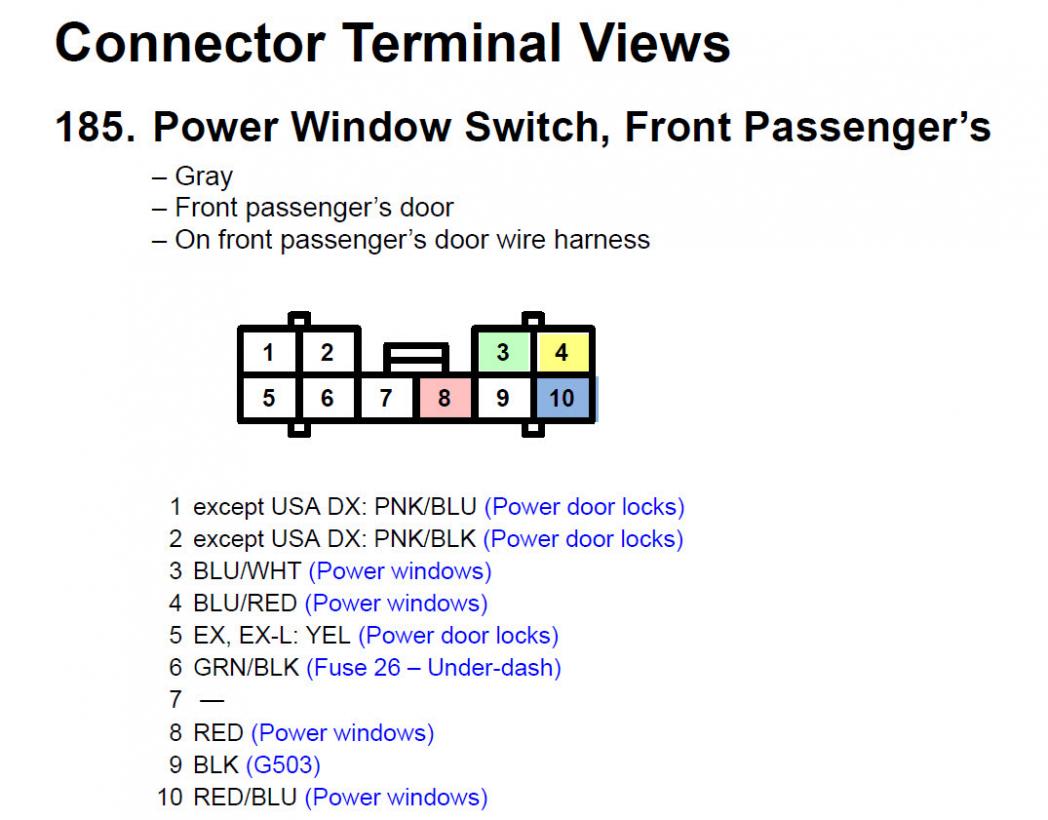
2. The following is to rule out the motor being damaged/bad. With the gray 10P connector at the passenger side window switch unplugged, apply direct 12 volt battery power (+) and ground (-) to cavity terminal no. 8 (Red wire) and cavity terminal no. 10 (Red/Blu wire).
Power (+) to the terminal no. 10 - Red/Blu wire and ground (-) to the terminal no. 8 - Red wire should make the regulator go up; switching power and ground to these respective wires should make the regulator go down. Only do these briefly, so as not to burn out the motor if it is good.
Try this, this is partially from my previous post #11.
1. Check that under-dash Fuse No. 26 (20A) is not blown. Power from Fuse 26 allows the passenger to operate the switch on the passenger side.
2. The following is to rule out the motor being damaged/bad. With the gray 10P connector at the passenger side window switch unplugged, apply direct 12 volt battery power (+) and ground (-) to cavity terminal no. 8 (Red wire) and cavity terminal no. 10 (Red/Blu wire).
Power (+) to the terminal no. 10 - Red/Blu wire and ground (-) to the terminal no. 8 - Red wire should make the regulator go up; switching power and ground to these respective wires should make the regulator go down. Only do these briefly, so as not to burn out the motor if it is good.
Super Moderator
Joined: Oct 2010
Posts: 7,099
From: United States
The following is just info. if you want to understand how the front passenger window switch works:
The front passenger window switch has a separate open relay and close relay. They work together to operate the window motor. When you press open, the open relay is energized to provide power (+) through the Red/Blu wire to the motor and the close relay provides ground (-) through the resting relay contact through the Red wire to the motor. When you press close, the close relay is energized and provides power to the motor while the open relay provides ground through the resting relay contact to the motor, and the motor goes in the opposite direction.
The front passenger window switch has a separate open relay and close relay. They work together to operate the window motor. When you press open, the open relay is energized to provide power (+) through the Red/Blu wire to the motor and the close relay provides ground (-) through the resting relay contact through the Red wire to the motor. When you press close, the close relay is energized and provides power to the motor while the open relay provides ground through the resting relay contact to the motor, and the motor goes in the opposite direction.
Newest Of Newbies
Joined: Aug 2014
Posts: 16
Thanks, this is the same info that is at the end of the Dorman regulator replacement instructions. I tried all of these procedures multiple times to no avail.
Newest Of Newbies
Joined: Aug 2014
Posts: 16
The passenger window switch has two relays built into it.
Try this, this is partially from my previous post #11.
1. Check that under-dash Fuse No. 26 (20A) is not blown. Power from Fuse 26 allows the passenger to operate the switch on the passenger side.
2. The following is to rule out the motor being damaged/bad. With the gray 10P connector at the passenger side window switch unplugged, apply direct 12 volt battery power (+) and ground (-) to cavity terminal no. 8 (Red wire) and cavity terminal no. 10 (Red/Blu wire).
Power (+) to the terminal no. 10 - Red/Blu wire and ground (-) to the terminal no. 8 - Red wire should make the regulator go up; switching power and ground to these respective wires should make the regulator go down. Only do these briefly, so as not to burn out the motor if it is good.
Try this, this is partially from my previous post #11.
1. Check that under-dash Fuse No. 26 (20A) is not blown. Power from Fuse 26 allows the passenger to operate the switch on the passenger side.
2. The following is to rule out the motor being damaged/bad. With the gray 10P connector at the passenger side window switch unplugged, apply direct 12 volt battery power (+) and ground (-) to cavity terminal no. 8 (Red wire) and cavity terminal no. 10 (Red/Blu wire).
Power (+) to the terminal no. 10 - Red/Blu wire and ground (-) to the terminal no. 8 - Red wire should make the regulator go up; switching power and ground to these respective wires should make the regulator go down. Only do these briefly, so as not to burn out the motor if it is good.
Newest Of Newbies
Joined: Aug 2014
Posts: 16
The following is just info. if you want to understand how the front passenger window switch works:
The front passenger window switch has a separate open relay and close relay. They work together to operate the window motor. When you press open, the open relay is energized to provide power (+) through the Red/Blu wire to the motor and the close relay provides ground (-) through the resting relay contact through the Red wire to the motor. When you press close, the close relay is energized and provides power to the motor while the open relay provides ground through the resting relay contact to the motor, and the motor goes in the opposite direction.
The front passenger window switch has a separate open relay and close relay. They work together to operate the window motor. When you press open, the open relay is energized to provide power (+) through the Red/Blu wire to the motor and the close relay provides ground (-) through the resting relay contact through the Red wire to the motor. When you press close, the close relay is energized and provides power to the motor while the open relay provides ground through the resting relay contact to the motor, and the motor goes in the opposite direction.
In one of my earlier posts I mentioned seeing power at the motor wires after the switch was released. Not sure if this is related to the relay clicking or not.
Super Moderator
Joined: Oct 2010
Posts: 7,099
From: United States
The car has anti-pinch windows. The power window motor incorporates a pulser which generates pulses during the motor's operation and sends pulses to the power window control unit. As soon as the power window control unit detects no pulses from the pulser, the power window control unit makes the power window motor stop and reverse. Although, it is mainly to prevent pinching your hands or fingers during the auto-up operation, it may be the cause of issues when it is going down too.
Newest Of Newbies
Joined: Aug 2014
Posts: 16
Try cleaning the window glass run channel with some rubbing alcohol and then lubing it with a silicone based lubricant.
The car has anti-pinch windows. The power window motor incorporates a pulser which generates pulses during the motor's operation and sends pulses to the power window control unit. As soon as the power window control unit detects no pulses from the pulser, the power window control unit makes the power window motor stop and reverse. Although, it is mainly to prevent pinching your hands or fingers during the auto-up operation, it may be the cause of issues when it is going down too.
The car has anti-pinch windows. The power window motor incorporates a pulser which generates pulses during the motor's operation and sends pulses to the power window control unit. As soon as the power window control unit detects no pulses from the pulser, the power window control unit makes the power window motor stop and reverse. Although, it is mainly to prevent pinching your hands or fingers during the auto-up operation, it may be the cause of issues when it is going down too.
I planned on cleaning and lubing the channel. That's something I read about in other threads.
Last edited by JeffN9; Sep 1, 2014 at 06:14 PM.