


Brake Light On Cluster Panel After Pressing Brake Pedal


Thread Starter
|
Newest Of Newbies
Joined: Jan 2015
Posts: 31
 Brake Light On Cluster Panel After Pressing Brake Pedal
Hello,
I have LED brake lights installed on my 2000 Accord and when I press the brake pedal, the little rear brake lights comes on in the instrument cluster and stays on. I have heard this happens because the computer thinks the rear brake light bulb is out because the LED's use much less of a load. I installed 25W resistors on the black and red wires and the light still comes on. There is also a green wire. Any ideas how to properly connect the resistors or how to make the rear brake lights stop coming on when I press the brakes?
I have LED brake lights installed on my 2000 Accord and when I press the brake pedal, the little rear brake lights comes on in the instrument cluster and stays on. I have heard this happens because the computer thinks the rear brake light bulb is out because the LED's use much less of a load. I installed 25W resistors on the black and red wires and the light still comes on. There is also a green wire. Any ideas how to properly connect the resistors or how to make the rear brake lights stop coming on when I press the brakes?

Senior Member
Joined: May 2012
Posts: 427
Why do you need 25 watt resistors? That is HUGE, 2 or less watts is plenty.
I would think you just need 100 ohm, 1/2 watt resistor and test it out on the black wire (in line... meaning just cut the black wire and put the resistor on the black wire only).
Best way to figure out which wire is "hot" is to take the LED off and have someone press on the brakes. Check the voltage of each wire and see which one is 12 volts. Then put the resistor on that wire before it goes into the LED.
I would think you just need 100 ohm, 1/2 watt resistor and test it out on the black wire (in line... meaning just cut the black wire and put the resistor on the black wire only).
Best way to figure out which wire is "hot" is to take the LED off and have someone press on the brakes. Check the voltage of each wire and see which one is 12 volts. Then put the resistor on that wire before it goes into the LED.
Thread Starter
|
Newest Of Newbies
Joined: Jan 2015
Posts: 31
Why do you need 25 watt resistors? That is HUGE, 2 or less watts is plenty.
I would think you just need 100 ohm, 1/2 watt resistor and test it out on the black wire (in line... meaning just cut the black wire and put the resistor on the black wire only).
Best way to figure out which wire is "hot" is to take the LED off and have someone press on the brakes. Check the voltage of each wire and see which one is 12 volts. Then put the resistor on that wire before it goes into the LED.
I would think you just need 100 ohm, 1/2 watt resistor and test it out on the black wire (in line... meaning just cut the black wire and put the resistor on the black wire only).
Best way to figure out which wire is "hot" is to take the LED off and have someone press on the brakes. Check the voltage of each wire and see which one is 12 volts. Then put the resistor on that wire before it goes into the LED.
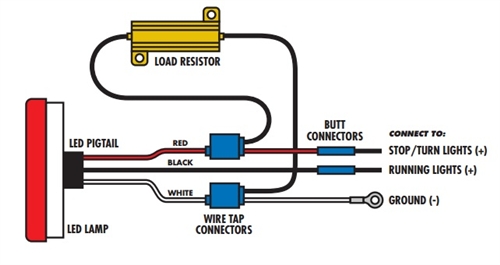
That seems to be the standard. Some sell 50W resistors. The resistor needs to connect to two wires (the hot brake light and the ground).
Similar to this:
Senior Member
Joined: May 2012
Posts: 427
I will have to look into it. From my electronic experience, I would have connected the resistor to the red wire only on the drawing. It wont hurt at all to use a 50 watt...
But if that is what came in the package, then go with it.
But if that is what came in the package, then go with it.
Thread Starter
|
Newest Of Newbies
Joined: Jan 2015
Posts: 31
Yes, the only problem is that I don't have a white wire, only black, red, and green. I'm wondering if the green wire is the ground. I can't find a diagram for these wires to tell me which wire is which.
Senior Member
Joined: May 2012
Posts: 427
I would guess that the white wire on the diagram is the green wire on your car, but it's not good to guess.
Best to disconnect the LED and use an ohm meter to check the green wire to your chassis ground (car). If it reads "zero" then that is "ground" for sure.
Then go one more step like I said earlier to check the voltage when someone presses on the brakes.
Best to disconnect the LED and use an ohm meter to check the green wire to your chassis ground (car). If it reads "zero" then that is "ground" for sure.
Then go one more step like I said earlier to check the voltage when someone presses on the brakes.
Thread Starter
|
Newest Of Newbies
Joined: Jan 2015
Posts: 31
I would guess that the white wire on the diagram is the green wire on your car, but it's not good to guess.
Best to disconnect the LED and use an ohm meter to check the green wire to your chassis ground (car). If it reads "zero" then that is "ground" for sure.
Then go one more step like I said earlier to check the voltage when someone presses on the brakes.
Best to disconnect the LED and use an ohm meter to check the green wire to your chassis ground (car). If it reads "zero" then that is "ground" for sure.
Then go one more step like I said earlier to check the voltage when someone presses on the brakes.

Thread
Thread Starter
Forum
Replies
Last Post
victorywhity
General Tech Help
4
Mar 24, 2011 09:37 PM
atsioukl
General Tech Help
12
Mar 20, 2010 10:51 AM


